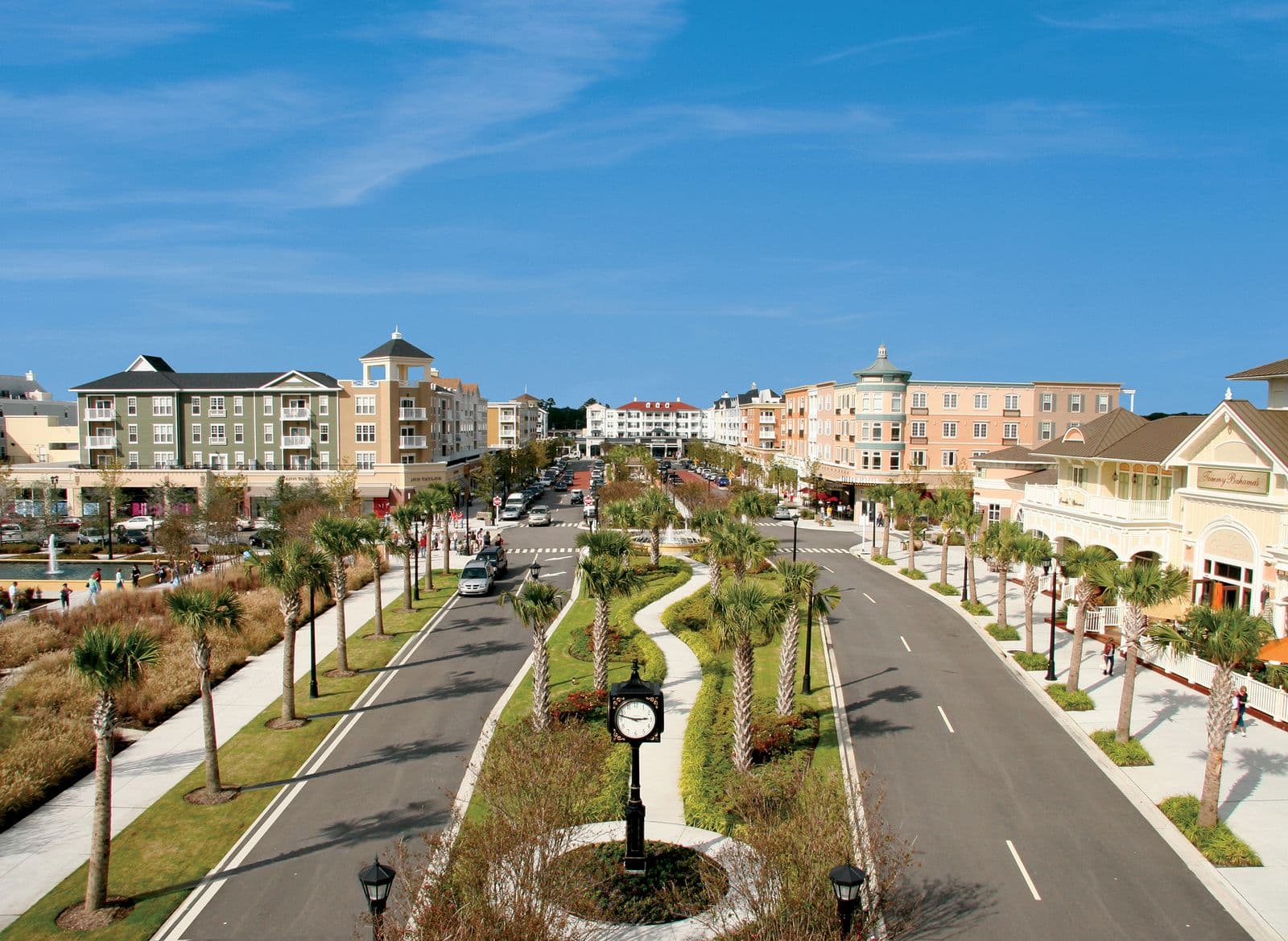
There's a reason VA financing comes up more here than in most markets. The Grand Strand's most-walked neighborhood is built on an Air Force base.
The City of Myrtle Beach describes it plainly: "the 3,936-acre former Air Force Base," which closed in 1993, "is now home to The Market Common and surrounding neighborhoods, with thousands of new homes, a dozen parks, walking trails and sporting facilities, along with Myrtle Beach International Airport, Whispering Pines Golf Course, the International Technology and Aerospace Park and other commercial, educational and residential developments." That redevelopment ran through the Myrtle Beach Air Base Redevelopment Authority and the city.
So when a veteran tells me they want to look at The Market Common, there's usually some history in it. Good news: a VA-backed loan is often the strongest financing on this coast, for a reason that has nothing to do with sentiment. Here's what it does, what it costs, and the two places it gets complicated locally.
What the VA Loan Actually Gives You
Straight from VA's own purchase loan page, the benefits are:
- "No down payment" — as long as the sales price doesn't exceed the appraised value.
- "No need for private mortgage insurance (PMI) or mortgage insurance premiums (MIP)."
- "Fewer closing costs, which may be paid by the seller."
- "No penalty fee if you pay the loan off early."
- A reusable benefit — you can "use your VA loan benefit again if you sell or refinance a home you bought with a VA-backed home loan."
The no-PMI point is the one I'd underline on the Grand Strand specifically. Insurance is already a live budget line down here — many properties need wind and hail coverage as a separate product, and coastal flood insurance on top. Removing mortgage insurance from a payment on a coast where two other insurance premiums are already competing for the same dollars is not a minor benefit. That's the practical case, and it's why I push veterans to at least price the VA option even when a conventional loan looks fine on paper.
VA lists three conditions, all of which must be met: you qualify for a Certificate of Eligibility (COE), you meet the lender's own standards, and "you will live in the home you're buying with the loan." That last one is a real constraint. The VA purchase loan is an owner-occupancy program. It is not a vehicle for buying a Grand Strand rental property, and that's the most common misunderstanding I run into in a resort market.
Entitlement and the Loan Limit Question
This is where most online explanations go stale, so take it from VA's loan limits page directly.
If you have full entitlement: "You don't have a loan limit (as long as you can afford the loan amount and the property appraisal supports the purchase price of the home)."
If you have remaining entitlement — typically because you have an active VA loan, or had one that wasn't fully restored — "your remaining bonus entitlement is based on the county loan limit where you plan to buy or refinance a home, minus the amount of your entitlement you've already used."
Two things follow. First, if someone tells you the VA caps what you can borrow and you have full entitlement, they're describing an old rule. Second, if you're a veteran who already owns a home financed with a VA loan — extremely common among buyers relocating here — find out what entitlement you actually have left before you go shopping, because that number, not the county limit, is what shapes your price range. Your lender pulls it with your COE.
The Funding Fee, and Who Doesn't Pay It
The VA loan isn't free; it's funded by a one-time fee. Per VA's funding fee page, for purchase loans effective April 7, 2023:
| Down payment | First use | Subsequent use |
|---|---|---|
| Less than 5% | 2.15% | 3.3% |
| 5% or more | 1.5% | 1.5% |
| 10% or more | 1.25% | 1.25% |
Notice the shape of that table. The jump from first to subsequent use only bites in the zero-down column — and putting 5% down drops a repeat user from 3.3% to 1.5%. On a $400,000 purchase that's a difference worth actually running the math on with your lender rather than defaulting to zero down because you can.
The exemptions matter more than the rates. VA states the fee doesn't apply if:
- "You're receiving VA compensation for a service-connected disability"
- "You're receiving Dependency and Indemnity Compensation (DIC) as the surviving spouse"
- You're an active-duty member who can "provide evidence that you received a Purple Heart"
If you're exempt, the largest single cost of the program disappears — and plenty of people who qualify don't realize they do. Ask your lender to confirm your exemption status against your COE before you budget closing costs.
One financing limit to plan around: on a purchase loan, VA states borrowers may "finance only the VA funding fee into the loan amount." Other closing costs are paid at closing, not rolled in. And seller concessions are capped — VA puts it at "no more than 4% of your home's reasonable value."
That 4% cap is a real negotiating tool in a market with the inventory levels the Grand Strand currently carries. Where a seller is motivated, concessions toward your closing costs or a rate buydown are frequently more achievable than an equivalent price cut. Ask for them deliberately.
For how a lender actually evaluates whether you can carry the payment — including VA's 41 percent debt-to-income standard and the residual income test that makes VA underwriting genuinely different from every other program — I've written that out in full in how much house you can afford here. It's the piece of VA underwriting most worth understanding, and it's the reason a VA denial from one lender isn't always a denial.
The Two Places VA Gets Complicated on This Coast
Condos
A very large share of what's for sale on the Grand Strand is a condo or a townhouse, and VA financing on a condo has a step conventional financing doesn't: the project matters, not just the unit. VA maintains its own record of condo projects reviewed for its programs, and lenders check a project's status there.
Practically: before you write an offer on a condo, have your lender check the project's VA status. If it isn't already in VA's system, getting it there is a process measured in weeks, not days, and it is not something you want to discover during a two-week due diligence window. It's worth settling on day one for any VA buyer looking at attached housing, because the answer can change which buildings are worth touring at all.
Everything else in the condo guide — master insurance, reserves, regime dues, rental restrictions — applies on top.
The appraisal
VA appraisals assess value and property condition against VA's requirements. On this coast, the condition items that come up are coastal ones: roof age and covering, moisture and wood-destroying-insect issues, crawl spaces, and anything deferred on an older beach cottage. A VA appraisal is not a home inspection and doesn't replace one — get your own inspector regardless.
The consequence to plan for is timing. If the appraisal calls for repairs, someone has to complete them before closing, and that negotiation happens under a clock. Build the possibility into your contract dates rather than assuming a clean pass.
South Carolina's Own Provisions for Veterans
These are state provisions, separate from anything the VA does, and they change the arithmetic of owning here in ways the VA loan itself does not.
Property tax exemption for permanently and totally disabled veterans. S.C. Code § 12-37-220(B)(1) provides an exemption for the dwelling of "a veteran of the Armed Forces of the United States who is permanently and totally disabled as a result of a service-connected disability and who files with the Department of Revenue a certificate signed by the county service officer certifying this disability." The statute also extends to a qualified surviving spouse, including "the surviving spouse of a member of the Armed Forces of the United States who was killed in action... if the surviving spouse remains unmarried, resides in the house, and has acquired ownership of the house in fee or for life."
Note the mechanics: it runs through a filing with the Department of Revenue and a certificate from the county service officer. It is not automatic on closing. File it.
Military retirement income is fully deductible. S.C. Code § 12-6-1171 provides that "an individual taxpayer may deduct all military retirement income that is included in South Carolina taxable income." No dollar cap in the statute's own terms. If you're drawing military retirement pay and comparing South Carolina against other states, that's frequently the deciding line in the spreadsheet.
Stack that with the ordinary owner-occupied rules. South Carolina assesses an owner-occupied legal residence at 4% rather than the 6% non-owner-occupied ratio — the property tax guide walks through how that works and what you have to file to get it.
I'm not a CPA and these provisions have conditions and filing requirements I'm not qualified to apply to your situation. Take the citations to a South Carolina tax professional and to the county service officer.
The Order I'd Actually Do This In
- Get your COE and your remaining entitlement, before you look at a single house. It sets your real price range.
- Confirm your funding fee exemption status. It can move your cash-to-close by five figures.
- Get fully pre-approved, not pre-qualified — see how pre-approval works in South Carolina.
- Decide attached or detached early. If condos are in play, VA project status becomes a day-one filter.
- Price insurance before you're emotionally committed. Wind and hail and flood are feasibility questions on this coast.
- Plan your concession ask against the 4% cap, deliberately, as part of your offer strategy.
- File your South Carolina exemptions after closing. The 4% legal residence ratio, and the disabled veteran exemption if it applies. Nobody does it for you.
Frequently Asked Questions
Is there a VA loan limit in Horry County? If you have full entitlement, VA states you don't have a loan limit, as long as you can afford the loan and the appraisal supports the price. County loan limits come into play for calculating remaining bonus entitlement when some entitlement is already in use.
Can I use a VA loan for a beach rental or second home? No. VA's stated condition is that "you will live in the home you're buying with the loan." It's an owner-occupancy program.
Do I pay PMI on a VA loan with nothing down? No. VA states there's "no need for private mortgage insurance (PMI) or mortgage insurance premiums (MIP)." The one-time funding fee is the program's cost, and some veterans are exempt from that.
Can the seller pay my closing costs? Often, yes — VA's own page lists "fewer closing costs, which may be paid by the seller" among the benefits, with seller concessions capped at "no more than 4% of your home's reasonable value." Whether a particular seller will is a negotiation.
Can I roll my closing costs into the loan? On a purchase, VA states you may "finance only the VA funding fee into the loan amount." Other costs are paid at closing. What to bring to closing in South Carolina covers what that day looks like — and remember South Carolina is an attorney-closing state.
Can I use my VA loan more than once? Yes — VA describes it as a benefit you can "use again if you sell or refinance a home you bought with a VA-backed home loan." What matters for your next purchase is how much entitlement is restored and available.
Am I exempt from the funding fee? If you're receiving VA compensation for a service-connected disability, receiving DIC as a surviving spouse, or are an active-duty member with evidence of a Purple Heart, VA lists you as exempt. Confirm it with your lender against your COE.
Let's Use the Benefit Properly
The veterans I work with here usually aren't short on information about the VA loan — they're short on someone who'll tell them which specific buildings on this coast will actually finance with it, and which appraisal items are going to come back on a 1980s beach cottage.
That's the local half of it, and it's the half a national lender page can't give you. Bring me your entitlement figure and the neighborhoods you're considering, and I'll tell you honestly where the friction is. Start with current listings, read about the communities here, or get in touch. My client resources page lists the lenders, attorneys and inspectors I work with — ask me which of them you want for a VA file and I'll point you at the right one.
Thank you for your service — and for what the base that became The Market Common meant to this town.
This article summarizes program terms published by the U.S. Department of Veterans Affairs and provisions of the South Carolina Code as of writing; VA program terms, fees and requirements change. Confirm current terms with VA and a VA-approved lender, and confirm tax treatment with a South Carolina tax professional and your county service officer. This is not legal, tax, or lending advice, and I am not a mortgage lender.
Thinking about making the move to the Grand Strand?
Whether you're relocating from up north or planning your retirement on the South Carolina coast, I'd love to help you get there. Follow me on Facebook for more local tips, search Grand Strand listings right here on my site, and join one of my Facebook groups built specifically for people making this move: