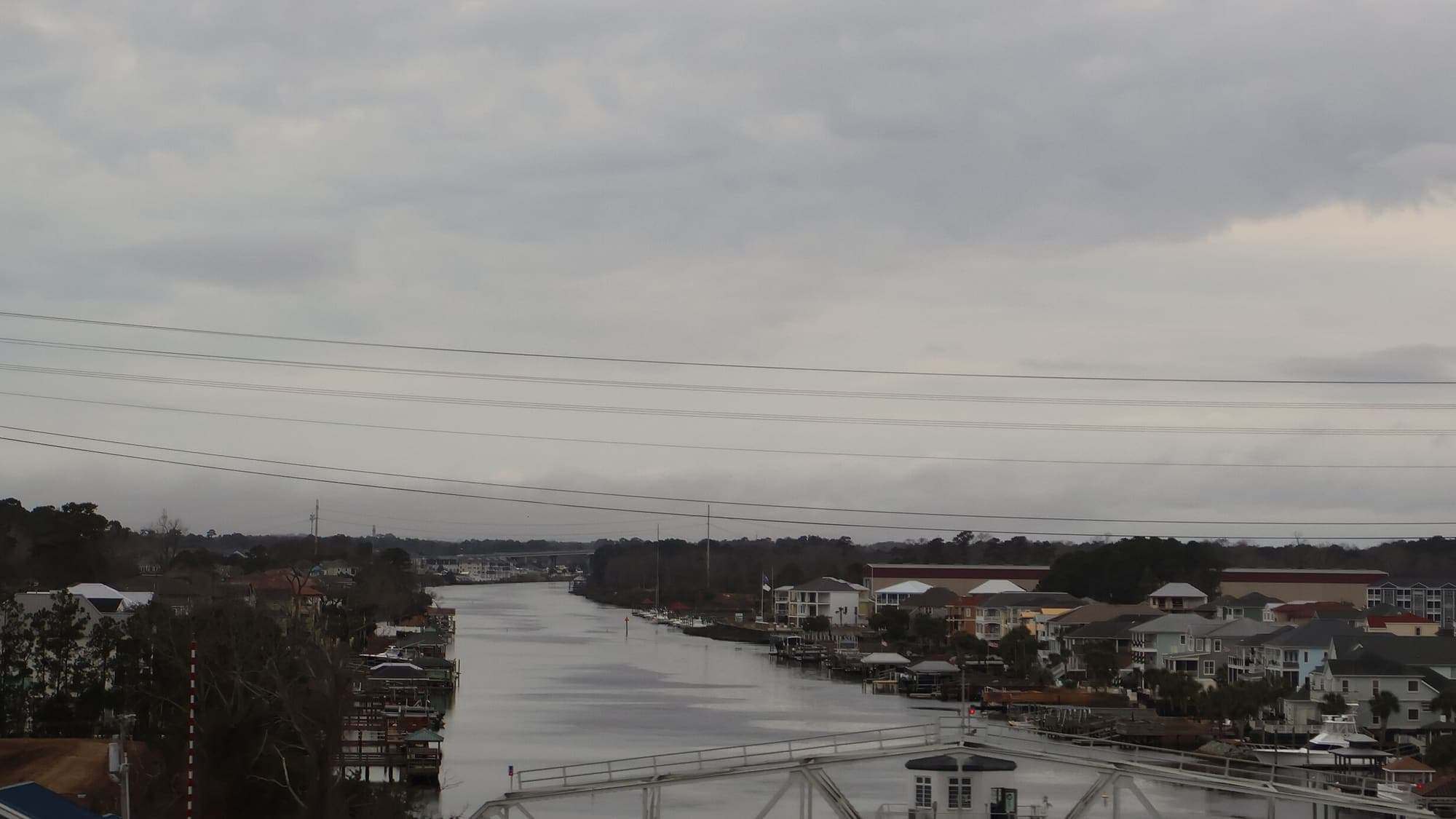
Indian Wells Golf Club opened in Garden City in 1984 and closed in December 2019. Almost seven years later, the land behind Garden Grove Townhomes is still empty. In April 2026 neighbors told WMBF they were finding car parts, bottles and other trash on the property, that trash was being dumped along the power line road, that people had set up campsites there, and that there had been break-ins. One resident said the noise carried at night and she thought it could be a danger to the community — and also that it was a beautiful spot people liked to walk, and that somebody could simply mow it and make it usable.
If you own a house that backs onto a Grand Strand course that has closed — or one you're worried might — the questions are the same ones those neighbors are asking. Can they build there? Did somebody already approve something? Is anyone still planning anything at all?
I went through Horry County's own zoning, parcel and Planning Commission records to answer that for this specific site. The short version is that almost every assumption people make about a closed course is the wrong one, and the two biggest are these: the rezoning everybody fought was never approved, and it never needed to be.
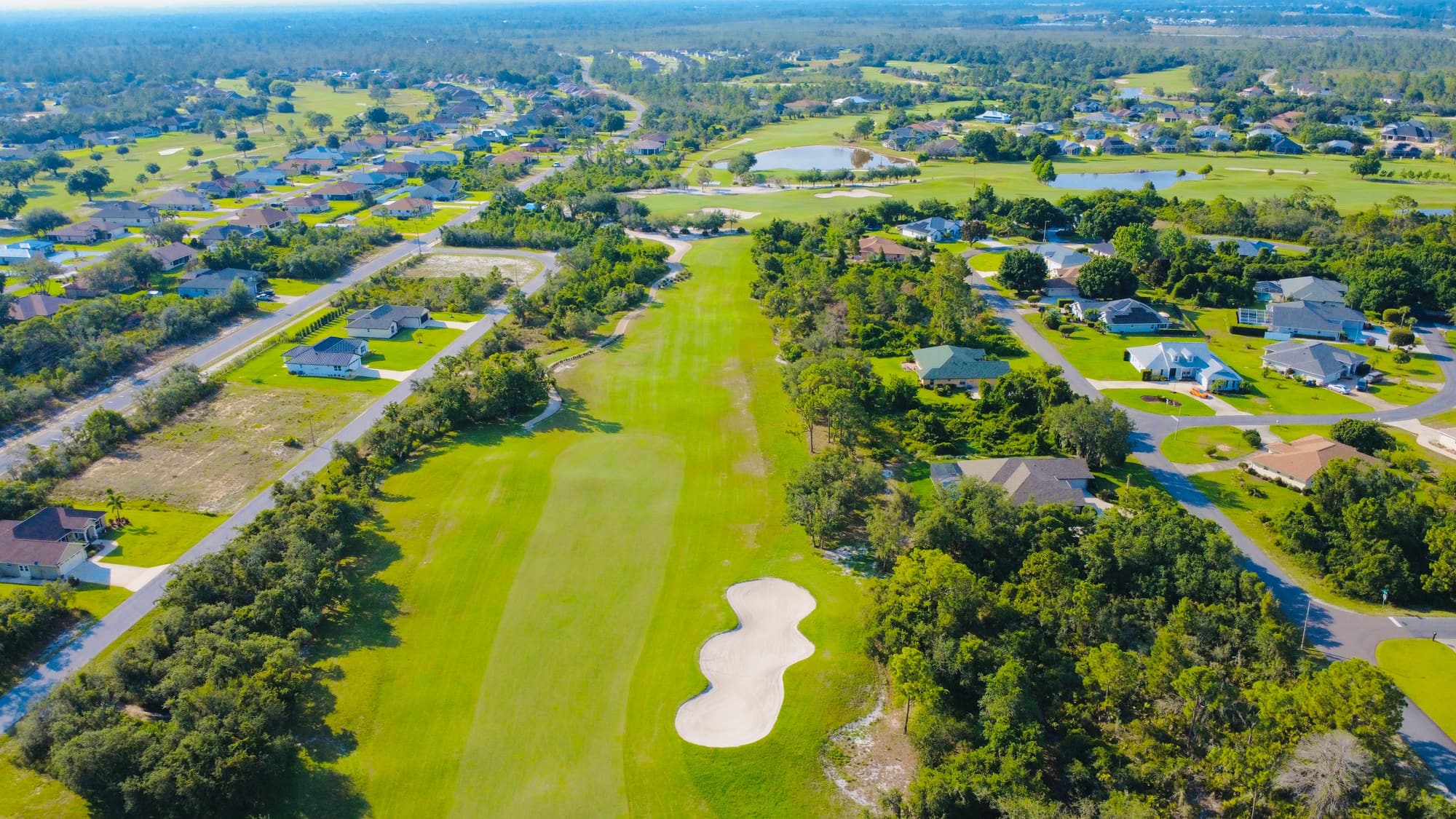
That arrangement is the whole issue. When you buy a house on a fairway, the open space behind you belongs to somebody else, and what happens to it is governed by that parcel's zoning — not by whether the course stays open. Garden City sits at the south end of the Strand between Surfside Beach and Murrells Inlet; our Surfside Beach and Garden City guide covers the area more broadly.
What actually happened at Indian Wells
Here is the sequence, and I've put what each step actually was next to it, because that's where this story gets misread.
| When | What happened | What that step actually was |
|---|---|---|
| 1984 | Indian Wells Golf Club opens | — |
| Dec 2018 | Founders Group files a rezoning request with Horry County | An application. Nothing more |
| Jan 2019 | County Council sends the plans back to the Planning Commission | Not a denial — a return for more work |
| 4 Apr 2019 | Planning Commission votes unanimously to recommend approval of a revised plan — 520 units of houses and townhomes, roughly 100 fewer homes than the first version, plus some business use | A recommendation. The Commission does not decide rezonings |
| May 2019 | Council defers action, and invites the owner's lawyers to speak in June | Still undecided |
| 18 Jun 2019 | Council defers the request indefinitely | Neither approved nor denied. It simply stops |
| Oct 2019 | Closure announced for December; the plan being discussed is described as 563 homes | A proposal, and by now a moving one |
| Dec 2019 | The course closes | — |
| Mar 2021 | Site clearing, road and utility work under way under a land disturbance permit, for a community called Middlebrooke — reported then as 488 homes including 150 duplexes | Site preparation. Not home construction |
| Jul 2024 | Still nothing built. The owner's public relations contact tells The Sun News he is not aware of any development plans for the project | — |
| 4 Dec 2025 | The Planning Commission approves three one-year vested-rights extensions covering eight Middlebrooke phases. The applicant says the roundabout and other offsite improvements are complete | Development rights kept alive for another year |
| Apr 2026 | Residents report dumping, campsites and break-ins; the owner does not respond to requests for an update | — |
Notice what the unit count does across that table: 693 in one recap, 563 in October 2019, 520 in the plan the Commission recommended, 512 in another account of the original filing, 488 in the 2021 reporting. Those are revisions of a moving proposal, not five different projects, and no single one of them is "the number." If somebody tells you a specific figure is what's coming to a closed course, ask which year they got it from.
The rezoning was never approved — and it never mattered
This is the part that surprises people, and it's the single most useful thing in this article.
The land is zoned SF 6. I checked that directly against Horry County's own zoning layer rather than taking a news report's word for it, and all three parcels come back the same. SF 6 is a residential district. Houses were always allowed there.
That was true throughout the fight. When WBTW covered the April 2019 Planning Commission vote, it put it plainly: houses can already be built on the golf course. The rezoning wasn't asking permission to build homes. It was asking for a different set of rules — more units than the base zoning would yield, and some commercial use alongside them.
You can see the neighbors working this out in real time. The WoodLake Village homeowners association voted 151 to 142 to support the rezoning, and its president explained why: if the board had decided on its own it wouldn't have supported it, but development could already happen there regardless. Faced with a choice between the plan they could negotiate and the one the owner could build without asking anyone, a narrow majority took the negotiated one.
Then County Council deferred the request indefinitely in June 2019, and the negotiated version died. What survived is what was always there: land zoned for houses.
So when a neighbor tells you "they got turned down," the honest answer is that the rezoning stopped, nobody voted it down, and the owner never lost the right to build homes.

What Horry County's records say about this land right now
I pulled the following from the county's public parcel, zoning, permit and subdivision data in early September 2026.
| What | What the county's record says |
|---|---|
| Owner of record | Founders IWGC LLC, on all three parcels |
| The land | Three parcels totalling 156.99 acres — PIN 46200000340 (77.27 ac), 46200001025 (39.14 ac) and 46200001026 (40.58 ac) |
| Zoning | SF 6 on all three. Unchanged |
| Acquisition | The main parcel's recorded sale date is 25 September 2014, deed book 3766, page 2251 |
| Legal descriptions | "INDIAN WELLS; HWY 17 BYPASS REM OF PR ABC", "LONGBRANCH DEVELOPMENT; PARCEL A" and "ASHTON WOODS; PARCEL B" |
| Open rezoning case | None on these parcels in the county's current rezoning records, which covered February to July 2026 when I checked |
| Building permits | None on these parcels in the county's current permit records, which covered June to July 2026 when I checked |
| Recorded subdivision | The county's subdivision layer still carries "Indian Wells Golf Course." There is no recorded "Middlebrooke" |
Two things in that table deserve more than a glance.
The first is that this is three parcels now, not one. In 2019 it was a single golf course. Somewhere between then and now, plats were recorded that split it — and two of the new parcels carry legal descriptions naming Ashton Woods and Longbranch Development. I want to be careful here, because this is exactly the kind of detail that gets over-read: those are the names sitting in the county's plat descriptions, and Founders IWGC LLC is still the owner of record on all three parcels. It is evidence that the land has been carved up in preparation for something. It is not confirmation of who will build, or that anyone will.
The second is that "no open case at the county" does not mean "nothing can happen." It is what by-right development looks like. A project that already complies with its zoning doesn't appear on a rezoning agenda, because it isn't asking for anything.
And a caution on those last two rows: the county's public permit and rezoning datasets only carry a rolling recent window, so what I checked rules out new activity in mid-2026 and nothing earlier. Absence there is not proof of absence.
"Abandoned" is the wrong word — and this is why
Here is the finding that changed my read of this site entirely.
On 4 December 2025, three items appeared under "Vested Rights" on the Horry County Planning Commission's agenda. All three were filed by Robert S. Guyton, acting as agent for Founders IWGC, LLC:
- Middlebrooke Phase 1A & 3A — PIN 462-00-00-1025
- Middlebrooke Phase 1B, 3B & 4 — PIN 462-00-00-1026
- Middlebrooke Phase 2, 5A & 5B — PIN 462-00-00-0340
Eight phases, across the three parcels, four months before the news coverage describing the site as run-down and unanswered-for.
All three were approved. The county's own recording of that meeting has the Commission taking each one separately — a motion to approve, a second, a show of hands, "motion carries" — with no opposition recorded on any of the three. The record states the extension period as one year.
Vested rights are a South Carolina statutory creature, and the mechanism is worth understanding because it explains how land can look dead and be legally very much alive. Under South Carolina Code § 6-29-1530, a vested right is established for two years once a site specific development plan is approved. The statute then requires local governments to run a process by which a landowner can apply, at the end of that period, for an annual extension — and it says the local governing body "must approve applications for at least five annual extensions" unless the rules have since been changed to prohibit it.
Section 6-29-1540 sets where that clock starts: no later than the approval that lets a developer "proceed with investment in grading, installation of utilities, streets, and other infrastructure." That is precisely the stage Indian Wells reached in 2021.
So the picture is not a developer who walked away. It is an owner going back to the county to keep a development entitlement from expiring on land that looks abandoned from the road — and a protection that is generous, but finite. How many extensions have already been used, I don't know; December 2025 is the one I can document.
There was one more thing on that recording worth knowing. Speaking to the Commission, the applicant said the project had been approved as one and permitted as three separate phases, that the offsite improvements including the roundabout have been completed, and that what remains is the internal work inside the subdivision.
That reframes the 2021 site work. It didn't simply stop halfway. The expensive part that faces the public road — the entrance, the roundabout at the Garden City Connector — got finished. What hasn't happened is everything behind it.
The four things that can happen to a closed course
Across the Grand Strand, closed courses end up in one of four places.
It gets built as planned. The developer has the zoning, the plan and the money, and homes go up more or less as advertised.
It gets built as something else. The entitlement survives but the plan doesn't. Different builder, different product mix, different phasing, often years later and at a density the original neighbors never saw drawn.
It becomes something other than housing. A park, a school site, a conservation easement, a stormwater project. This is the outcome neighbors most often ask for — Garden City residents have said publicly they'd rather have walking and biking paths than more houses — and it is also the one that requires someone to buy the land, which nobody has offered to do here.
Nothing happens, for years. Nobody plans for this one and it is what Indian Wells has actually delivered for close to seven years: a large piece of ground that is neither a course nor a neighborhood, maintained by nobody. Note how this version of "nothing" actually looks, though — an entrance and a roundabout built to the edge of an empty site, and development rights still being renewed at the county as recently as December 2025. That is not a project someone forgot about. It is one that is waiting.
If you're buying a home on a fairway anywhere on the Strand, the fourth outcome is the one to price into your thinking, because it's the one no listing will mention.
How to tell what stage a plan is really at
Most of the bad information in a neighborhood comes from collapsing these into "they're building." They are not the same, and the distance between the top and the bottom of this list can be a decade.
| Stage | What it actually means |
|---|---|
| Zoned for it | The use is already allowed. No application, no hearing, no vote |
| Applied | Somebody filed. It may be withdrawn tomorrow |
| Recommended | A planning commission likes it. It has decided nothing |
| Deferred | Put off. "Indefinitely" means it stops without ever being voted down |
| Denied | Actually refused |
| Approved | The elected body voted yes |
| Vested | The approval is protected for a set period, and can be extended |
| Permitted | A permit has been issued — often for clearing and utilities, not houses |
| Under construction | Something is genuinely being built |
Two traps in particular. Deferred is not denied — a deferred case leaves the applicant's rights exactly where they were. And approved is not built: an approval is permission, not a schedule, and permission can sit unused for as long as the vesting rules allow.
What to check about your own property
If you own near a closed or struggling course, this is the order I'd work in.
1. Find out what the land is actually zoned. Not what it's used for — what it's zoned. This is the question that decides what can happen without anyone asking you. Horry County publishes its zoning data, and the Planning and Zoning department will tell you the district for a specific parcel over the phone.
2. Find out who owns it. Parcel records are public and a corporate owner's name is right there. An owner who bought a decade ago and is still paying taxes on empty land is behaving differently from one who has quietly sold.
3. Check whether there's an open case. Planning Commission and County Council agendas are published before meetings. Remember that a site building by right won't appear on any of them — no case is not the same as no plans. Note too that from 16 March 2026 Horry County requires a free user login to reach county online platforms that display property address information, including GIS, Land Records and Tax & Assessor services, so some lookups now need an account that didn't used to.
4. Ask the question nobody asks: are there vested rights, and how many extensions are left? This is the single most useful call you can make to a planning department about a stalled site. Two years plus annual extensions is a finite runway, and where a project sits on it tells you far more than a rumor does.
5. Read your own covenants. What an HOA can or can't do about adjacent land depends entirely on the specific documents and the specific facts — it's worth reading them and, if it matters, getting real advice rather than a summary. Our guide to buying in a Myrtle Beach HOA covers how those documents work.
6. Be honest with yourself about what the view was worth. I'm not going to put a number on what a closed course does to a home's value, because I don't have local sold data that would support one and I'm not going to invent it. What I can tell you is the mechanism: what you bought was open space, a long sight line and no immediate neighbor behind you. Whether that's preserved, replaced with houses, or left as unmaintained ground is the actual question, and it's answered by zoning and entitlements — not by whether the course reopens.
What we still don't know about Indian Wells
I'd rather leave these open than fill them with a confident guess.
- How many annual extensions have already been used, and therefore when the entitlement actually runs out. December 2025 was one of them. Two years plus at least five annual extensions is a finite runway, and nobody outside the county and the owner currently knows where this site sits on it. This is the most important open question here.
- The lot counts for each phase. Staff read them out at the December 2025 meeting, but the county's automated captions garble numbers badly enough that I won't repeat them.
- Whether the Ashton Woods and Longbranch names on the legal descriptions represent parties who will actually build, or are simply plat labels.
- Whether the county has taken any code-enforcement action over the site's condition. I found nothing.
- Whether anyone still intends to build 488 homes, or any homes at all. The last unit figure published for this site was in 2021.
Frequently asked questions
Can they build houses on the golf course behind my home? It depends entirely on the zoning of that specific parcel, not on whether it used to be a course. At Indian Wells the land is zoned SF 6 and houses have always been allowed, which is why the failed rezoning changed less than people assume. Check the zoning of your own neighbor parcel before assuming either way.
Does a closed golf course lower my property value? I won't give you a percentage, because I don't have sourced local sold data for that and a made-up figure would be worse than no figure. The honest framing is that what changes is the land behind you — open space with a long sight line becomes either houses, something else, or unmaintained ground. Which one it becomes is decided by zoning and entitlements, and that's what's worth finding out.
Who owns the closed course, and can I find out? Yes. Parcel ownership is a public record in Horry County. Indian Wells is owned by Founders IWGC LLC across all three of its parcels.
Can homeowners or an HOA stop a redevelopment? If a project needs a rezoning, there's a public process and neighbors have real influence — the Indian Wells rezoning stalled after sustained opposition. If a project complies with existing zoning, there is no such hearing to show up to. What your HOA can do beyond that depends on its own covenants.
Was the Middlebrooke development ever actually approved? The 2019 rezoning was not — Council deferred it indefinitely. But the development itself proceeded under the existing SF 6 zoning, and by December 2025 the applicant was describing it to the Planning Commission as having been approved as one project and permitted as three phases, with vested rights the Commission then extended for another year. Those are two different things, and conflating them is how people end up believing the site was blocked.
How do I find out what's actually approved rather than rumored? Ask the county three separate questions: what is this parcel zoned, is there an open case on it, and does it carry vested rights. The answers to those three tell you almost everything a neighborhood rumor gets wrong.
If this is about a specific address
Every closed course is its own situation, and a general article can only take you so far. If you own near one — Indian Wells, or any of the Grand Strand courses that have gone quiet from Murrells Inlet north — the useful next step is to look at what's actually approved and entitled on the land nearby, and what that means for your particular house.
That's a conversation worth having before you make a decision about selling, not after. If you're weighing a home on or near a fairway, our comparison of new construction and resale and the Surfside Beach and Garden City guide are both useful background.
Thinking about making the move to the Grand Strand?
Whether you're relocating from up north or planning your retirement on the South Carolina coast, I'd love to help you get there. Follow me on Facebook for more local tips, search Grand Strand listings right here on my site, and join one of my Facebook groups built specifically for people making this move: